
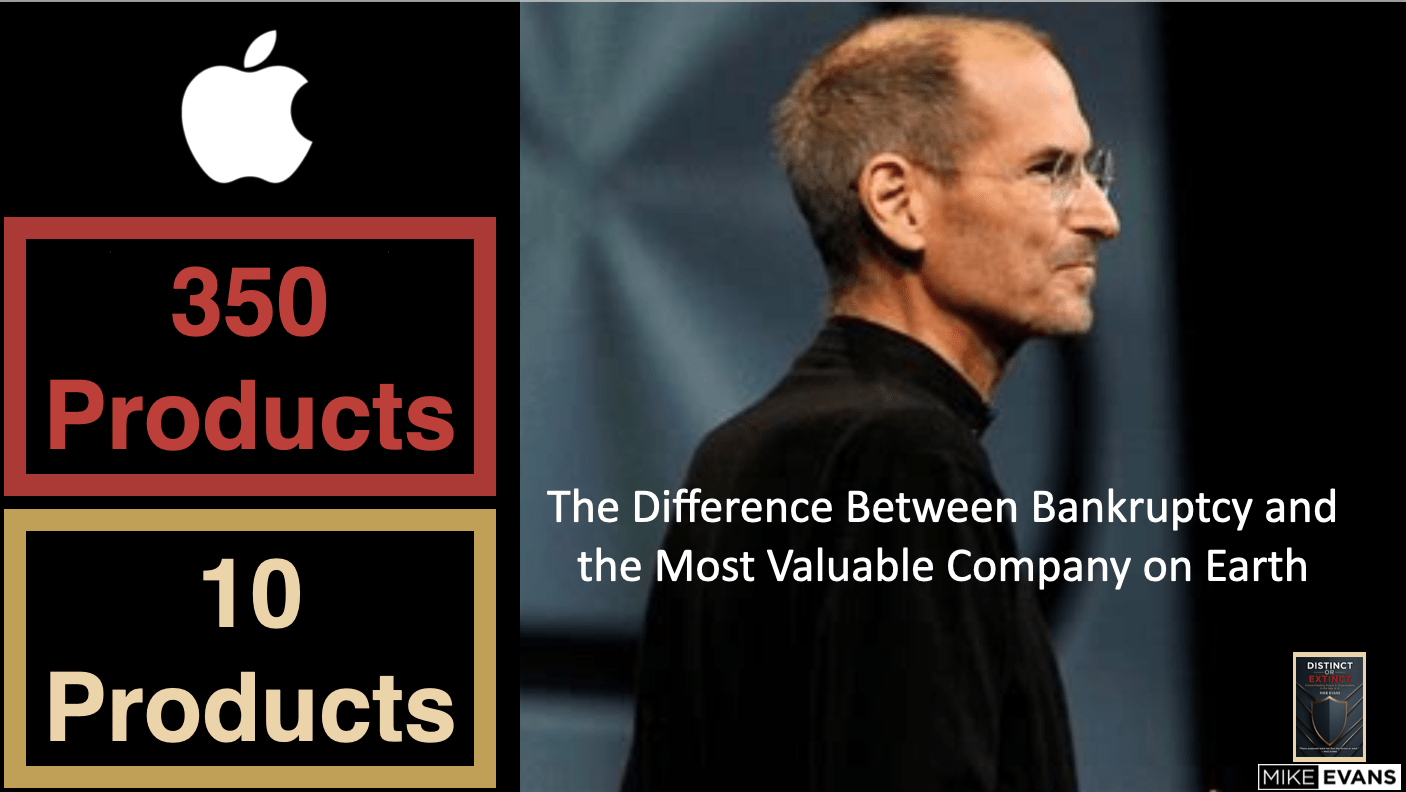
Steve Jobs Cut Apple from 350 Products to 10. Your Organization Has Too Many Good Ideas. That Is Exactly the Problem.
In 1997, Steve Jobs demonstrated that leadership focus and execution — not more ideas, more products, or more initiatives — is what separates companies that survive from companies that don’t. He walked back into Apple and found a company 90 days from bankruptcy with 350
The problem was not that Apple had bad products. The problem was that Apple had 350 of them.
350 products. 350 directions. 350 competing claims on the same finite pool of talent, capital, and attention.
Jobs did not restructure the product line. He did not form a committee to evaluate priorities. He did not ask for a roadmap.
He asked one question: which ten products would we bet the company on?
Everything else got cut.
Within a year, Apple was profitable. Within a decade, Apple was the most valuable company on earth.
The difference between bankruptcy and the most valuable company on earth was not a better product. It was the discipline to focus on the critical few, and the courage to cut everything else.
That principle is one of the most important, and most consistently violated, in organizational leadership today. And in the age of AI, where the pace of new ideas is accelerating faster than any organization can absorb, it has never mattered more.
Leadership Focus and Execution: When Everything Is Important, Nothing Is
Here is the paradox most leaders face: the problem is rarely a shortage of good ideas. The problem is an abundance of them.
Every leadership team I have worked with has more good ideas than they have the capacity to execute flawlessly. More initiatives than they have the bandwidth to sustain. More priorities than their people can hold in their heads simultaneously.
And when organizations try to pursue everything at once, something predictable happens. Focus evaporates. Alignment breaks down. Engagement drops. Ownership disappears.
The people you lead, the ones you need giving you more than compliance, quietly revert to just doing their job. Not because they stopped caring. Because they stopped being able to see how their work connects to anything that actually matters.
When everything is a priority, nothing is a priority. When everything is urgent, nothing gets done well. And when leaders overwhelm their teams with more than can be executed with excellence, they do not get more output. They get a large, complicated, underperforming mess, and a workforce that has learned the hard way to keep their heads down and wait for the next reorganization.
This is what I call the law of diminishing returns applied to leadership: beyond two or three wildly important goals, every additional priority you add does not divide your organization’s focus evenly. It compounds the confusion exponentially.
The IDEAS Ingredient and the Discipline of the Critical Few
The first ingredient in the 5-Ingredient Kryptonite Defense is IDEAS, and it is frequently misunderstood.
Most leaders hear IDEAS and think: generate more of them. Be more creative. Build a culture of innovation. Hold more brainstorming sessions.
That is not what the IDEAS ingredient is about.
The IDEAS ingredient is about having the discipline to identify which ideas are worth everything, and the strategic clarity to cut everything else until those ideas are executed flawlessly.
It is not about having more ideas. It is about having the right ones, fully resourced, fully aligned, and fully owned by the people responsible for delivering them.
The challenge is real. Choosing the top two or three ideas from a list of dozens is one of the hardest things a leader can do. Every idea on that list has a champion. Every initiative has momentum. Every priority has a reason it got onto the list in the first place.
But the leaders who build organizations that last, the ones who navigate disruption instead of being consumed by it, are the ones who make that choice. They identify the two or three things that, if executed flawlessly right now, will propel the organization to a better position and secure its future. And then they resource those things completely, communicate them relentlessly, and protect them from the gravitational pull of everything else competing for attention.
That is what leadership focus and execution actually means in practice.
Focus Is Not Forgetting — It Is Sequencing
Here is the part that most leaders miss when they hear this principle: focusing on the critical few does not mean abandoning every other good idea.
It means sequencing them.
The goal is not to cut 340 ideas and never revisit them. The goal is to execute the top two or three with such focus and excellence that you achieve the result, and then replace them with the next most important ideas on the list.
This is how organizations build compounding momentum. Not by doing everything simultaneously at a mediocre level. But by doing the most important things sequentially at an exceptional level.
Steve Jobs did not eliminate the idea of building a phone in 1997. He eliminated everything that was getting in the way of Apple becoming a company worth building a phone with.
Sequencing is a leadership skill. It requires the confidence to say: this idea is important, and we will get to it, but not now. Right now, we are focused on this. And we will not divide our attention, dilute our resources, or confuse our people by pretending we can do both at the same level of excellence simultaneously.
The Change Leadership Dimension
This principle matters even more when an organization is navigating significant change — which, in the age of AI disruption, means every organization reading this.
One of the foundational principles of effective change leadership is this: you cannot engage the head and the heart of the people you lead if you are asking them to move in ten directions at once.
Change requires people to let go of what they know, step into uncertainty, and trust that the direction you are pointing them matters. That is an enormous ask. And it is an ask that people can only say yes to when they can see clearly what they are committing to, and why it matters above everything else.
When leaders overload their organizations with competing change priorities, they do not get change. They get the appearance of change, activity without movement, meetings without decisions, initiative names without outcomes.
What they lose is the one thing change requires most: ownership. And without ownership, you get compliance at best. Compliance will not get you through what is coming.
The organizations that will navigate AI disruption successfully are not the ones with the most ambitious transformation agendas. They are the ones that identified the one or two changes that matter most right now, and then brought their people along with full clarity, full context, and full commitment.
Leadership focus and execution is the prerequisite for change, not a nice-to-have.
Leadership Focus Execution: The Question Every Leader Must Answer
Here is the question Steve Jobs asked in 1997, and the question I believe every leader needs to answer honestly right now:
If you could only bet your organization on two or three things, two or three ideas, initiatives, or priorities that, if executed flawlessly over the next twelve months, would put you in a fundamentally stronger position, what would they be? The answer to that question is where leadership focus and execution begins.
Not twenty. Not ten. Two or three.
And then, is your organization actually structured around those two or three things? Are your resources aligned to them? Are your people clear on them? Are you protecting them from the noise?
If the honest answer is no, if your organization is running the 1997 Apple model, with 350 priorities competing for the same finite capacity, then the most important leadership decision you can make right now has nothing to do with AI, technology, or disruption.
It has everything to do with focus.
The IDEAS ingredient starts there. Not with generating more ideas. With having the discipline and the courage to choose the ones that matter most, and building an organization that can execute them with everything it has.
If you want to know where your organization stands across all five ingredients of the Kryptonite Defense — IDEAS, SPEED, TALENT, DISTINCTION, and LEADERSHIP AT ALL LEVELS — the Kryptonite Scorecard gives you a specific, measurable number in 15 minutes.
And if you are looking for a keynote that arms your leadership team with a framework they can act on — not just awareness they can nod at — you can learn more about what that looks like at realmikeevans.com/speaking/ai-disruption-keynote-speaker/.
Distinct or Extinct – Now Available on Amazon.
Those prepared need not fear the forces at work.